Part 2
In part 2 we’re going to make the sheep flock together and stop them disappearing off the screen. To do this we’re going to compute a force of attraction between the sheep. This will make the sheep move towards each other, and make them more interested in each other the closer they get.
Later we’ll also add an opposite force (a fear force) for the wolf so that the sheep run away!
We’re going to use a bit of maths to do this. Ready? Deep breath!
Here’s two sheep that we want to bring closer together. The red line is the force of attraction between them, you can see it works in a straight line between the sheep.
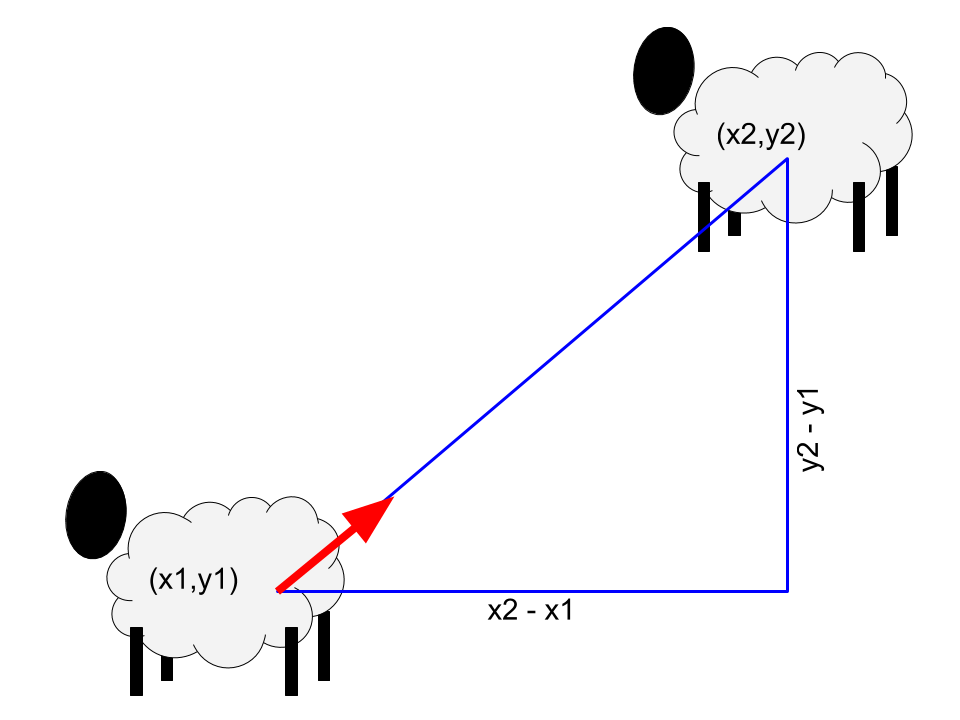
- So to calculate the force of attraction between two sheep we need to:
find the distance between them – we can easily find the difference in x and y values, and then we can use Pythagoras Theorem to compute the distance along the straight line
use distance to compute a force of attraction that gets stronger as the sheep get closer together, that’s how long the red line is
find the angle from one sheep to another
use the angle to move the sheep together.
Step 1: Distance with Pythagoras
Add a new method to your Animal class callled distance_to:
def distance_to(self, other):
    # Distances
    dx = self.x - other.x
    dy = self.y - other.y
    # Pythagoras
    return math.sqrt(dx**2 + dy**2)
Pythagoras states that the long edge of the right-angled triangle (the hypotenuse) is equal to the square root of the base squared (the difference in x) and the height squared (the difference in y).
Notice that to square something in Python we write something **
2.
With this method we can now compute the distance between any two sheep like this:
asheep.distance_to(another_sheep)
Step 2: Compute a force of attraction
Let’s add another method for this. Add this to your Animal class:
def attraction_to(self, other):
     # Attraction gets stronger the closer the other gets
     d = self.distance_to(other)
     return min(2, 30 / d)
So if the sheep is 300 pixels away, the force is 30/300 = 0.1, quite weak. At 30 pixels the force is 30/30 = 1, and at 15 pixels it is 30/15 = 2. This seems like a good start.
Now that we have the force, we can use it to move towards the other sheep…
Step 3: Find the angle between two sheep
Have you met sin, cos and tan yet in maths? They are three very handy functions that give us an angle if we know two sides of a triangle. So we know the difference in x and the difference in y, which means we can use tan to find the angle. Thanks SOHCAHTOA
Add this method to your Animal class:
def angle_to(self, other):
     return math.atan2(other.y - self.y, other.x - self.x)
Step 4: Use the angle to move the sheep
OK, so we know the angle, and we know the force, let’s move our sheep. But how? Our sheep understand changes in x and changes in y. If we know the angle and the force, we can use sin and cos to compute the x and y change. Thanks again SOHCAHTOA!
This is almost the last new method in this part, again add it to your Animal class:
def move_by_attraction(self, other):
    angle = self.angle_to(other)
    fx = math.cos(angle) * self.attraction_to(other)
    fy = math.sin(angle) * self.attraction_to(other)
    self.x += fx
    self.y += fy
Final step: bring it all together
OK, let’s bring those 4 steps together in our move method. Change it so that it looks like this:
 def move(self):
     for o in self.other_animals():
         self.move_by_attraction(o)
Finally we just need to write the method other_animals, which
gives us all other animals as we don’t want to move towards ourself!
def other_animals(self):
     """All the animals except us"""
     return [a for a in Animal.all if a != self]
Now Run and see what happens. Make sure you’ve created a few animals
first with Animals(). There’s a few bugs… note them down and have
a think about how we could solve them.
Bugs
Did you find some bugs? The big one is that these sheep end up on top of each other, which isn’t very realistic. Also we often get a divide by zero error when the distance between sheep becomes zero. Oh and the sheep can leave the screen.
Let’s fix these bugs…
Not too close
Look in your attraction_to function and you can see that attraction is equal to min(2, 30 / d). We can make a graph of this function so that we can see how it changes as the sheep get closer.
There are a few tools to draw graphs online, here’s one on Maths Is Fun
Let’s ignore the min function and just plot 30/x (using x instead of d because that’s what the graph tool wants):

Can you see that as the distance (x) decreases the force (y) gets stronger and stronger, with the blue line rising very steeply once x is less than 5.
What we want is for the force to decrease when the sheep gets closer than a certain amount and to become negative when they get too close, so that they don’t overlap.
What would this kind of graph look like? It could look something like this:
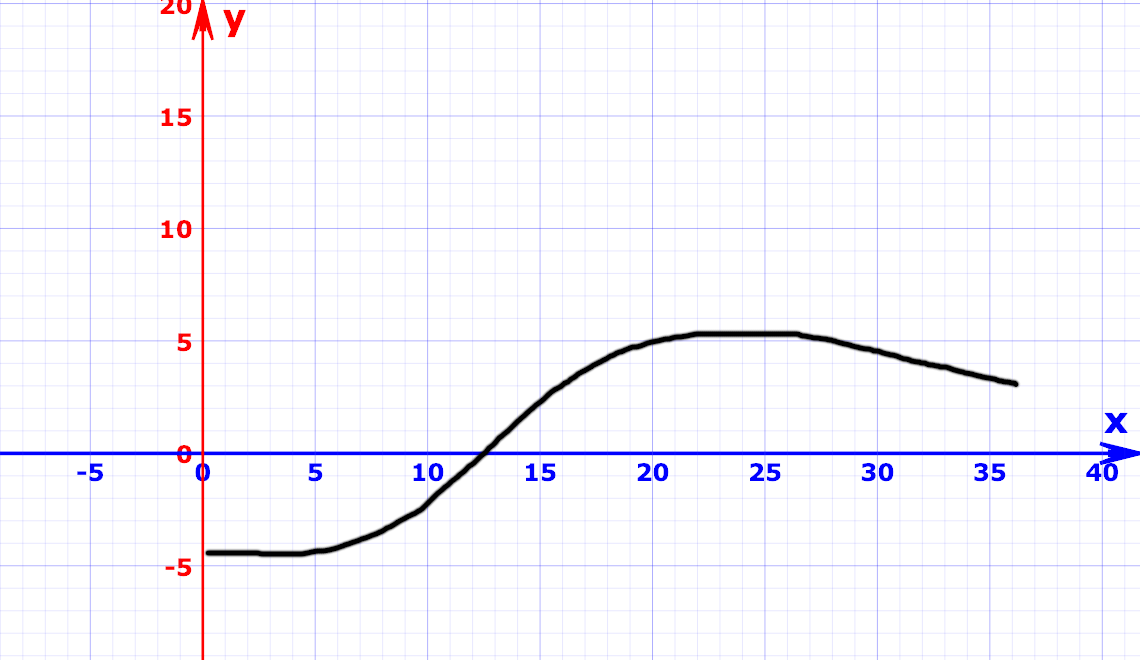
That is actually a bit like the graph of -cos(x), so let’s try that in our attraction_to function, change the yellow lines like so:
def attraction_to(self, other):
     d = self.distance_to(other)
     return -math.cos(d)
When you run this you’ll see that the sheep seem pretty happy with where they are, that’s because d is too big so let’s make it smaller by dividing it by 20.
def attraction_to(self, other):
     d = self.distance_to(other)
     return -math.cos(d/20)
So now your sheep form one or more flocks. Do try other numbers instead of 20 and see what you like.
If you want your sheep to move a bit slower, we can reduce the force by multiplying by a number less than 1, try this:
def attraction_to(self, other):
     d = self.distance_to(other)
     return 0.2 * -math.cos(d/20)
Divide by Zero?
Because our function now uses cos we never get a divide by zero error :)
